
By DailySunr | Research Feature
An Investigative Science & Living Case Study – When Science Meets Art: Biological Aesthetics – Natural Processes and Environmental Insight
In the stillness of a fridge left undisturbed during a holiday, something remarkable unfolded. Bathed in the low glow of a refrigerator light, a cluster of tomatoes, forgotten but intact, began a silent transformation. What followed was not mere spoilage, but a spectacle of microbial art.
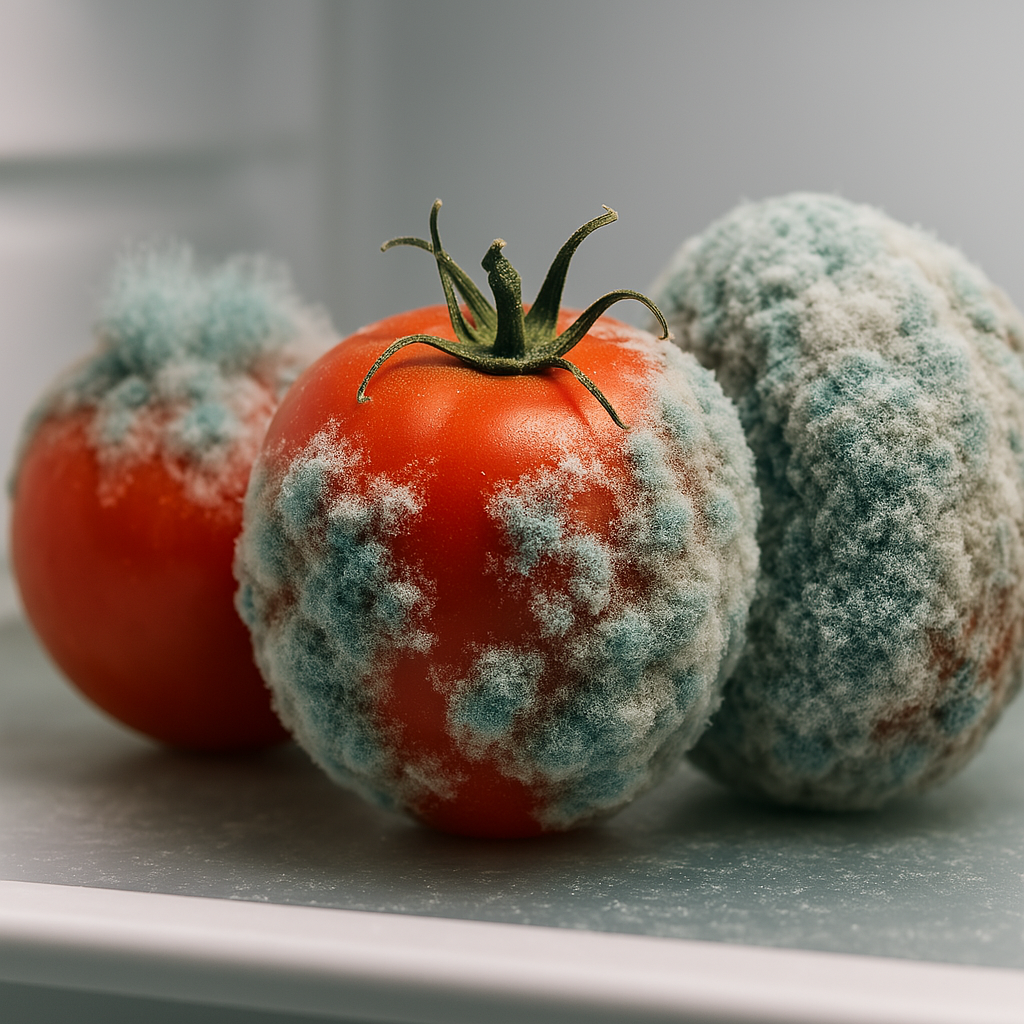
These tomatoes, stored cold and untouched, gradually bloomed with layers of mold. Their surfaces displayed strange and beautiful textures. Silken colonies in shades of ash, blue, green, and white curled like reefs. They rippled like forgotten planets. And yet, the skins held firm, almost reverent of the passage of time. The result was a tableau, unexpected, eerie, and oddly exquisite.
A Rare View of Domestic Microbiology
The phenomenon is known as saprophytic colonization, where fungal organisms decompose organic matter in low-oxygen, high-humidity environments. In this untouched fridge, conditions were ideal for growth and observation. Species such as Penicillium, Botrytis, and Cladosporium are commonly found on fruits. Their behaviour under refrigeration offers unique insight into fungal adaptation.

Microbiologists and food researchers have long studied such processes to understand antifungal resistance, spore patterns, and biological deterioration. This accidental exhibit offers a teaching moment not just for scientists, but for students, gardeners, and the wider public.
Key learning opportunities include:
- Microbial lifecycles in food preservation
- Household spoilage as a window into biological systems
- The intersection of art and science in domestic environments
- Composting cues and soil health indicators for gardeners
Beyond Spoilage: Philosophy in the Fridge

What made this moment haunting was the impulse not to discard the tomatoes. They evoked a quiet dignity, something between decay and preservation. In a culture that quickly rejects rot, this experience posed deeper questions: what does it mean to watch time unfold, unbothered, and why do we flinch at biological change?
Rot is not failure, it is process. It is the soft undoing of perfection, often with visual power that rivals deliberate artwork. Scientists see this through the lens of observation. Artists may see it as metaphor. For the rest of us, it is an invitation to rethink what decay reveals about life.

This photo captures the surface bloom of Penicillium mold overtaking a decomposing tomato, an image that blurs the line between decay and art. Under certain conditions, strains like this emit biofluorescent compounds detectable under UV light. The mold does not just feed, it signals, glowing faintly like a microbial Morse code.
Such visuals are increasingly used in research and education to illustrate mold identification, fermentation pathways, and post-harvest physiology. In soil science, similar organisms contribute to composting cycles that regenerate agricultural landscapes. For food security analysts, this image prompts critical reflection on waste patterns, preservation methods, and microbial ethics.
Ideal for science publications, gardening blogs, ecological textbooks, and visual editorial spreads, this image invites viewers to reconsider what beauty means at the microscopic level. It demonstrates that even in collapse, there is a code, a message of transformation, warning, and renewal.
Bibliography

1. Pitt, J.I., & Hocking, A.D. (2009). *Fungi and Food Spoilage*. Springer.
   — A foundational text exploring fungal species found in food, including moulds commonly seen on fruits.

2. Samson, R.A., et al. (2010). *Food and Indoor Fungi*. CBS-KNAW Fungal Biodiversity Centre.
   — Identifies fungal growth in refrigerated and household environments.

3. Doyle, M.P., & Buchanan, R.L. (2013). *Food Microbiology: Fundamentals and Frontiers*. ASM Press.
   — Offers insight into foodborne microorganisms, their lifecycles, and preservation challenges.

4. Haldane, J.B.S. (1927). “On Being the Right Size,” *Possible Worlds and Other Essays*. Chatto & Windus.
   — A philosophical essay touching on scale, perception, and scientific curiosity relevant to microbiological interpretation.

5. Parikka, J. (2012). *Insect Media: An Archaeology of Animals and Technology*. University of Minnesota Press.
   — Though primarily about insects, this work connects natural decay to art, media, and observation—a lens applicable to rotting food imagery.

6. Trudgill, P.W. (2001). “Composting and Microbial Succession,” *Microbial Biotechnology*, Vol. 3.
   — Describes soil and organic decay ecosystems relevant to gardener perspectives on rot.

7. Alexander, M. (1977). *Introduction to Soil Microbiology*. Wiley.
   — Includes chapters on decomposer fungi and their roles in soil health and nutrient cycling.

8. Levi-Strauss, C. (1966). *The Raw and the Cooked*. University of Chicago Press.
   — Anthropological examination of food, transformation, and symbolic meaning that underpins the philosophical tone of the article.

 Daily Sunrise